Cora Rusk
Needful ThingsCora Rusk is Brian and Sean Rusk’s mother, a watchful, irritable Castle Rock resident whose fixation on Elvis Presley makes her one of Leland Gaunt’s customers. Gaunt turns her rivalry with her best friend Myra Evans into leverage, selling Cora a pair of sunglasses that make her experience herself inside Graceland. The fantasy offers escape from the catastrophe consuming her family, but its collapse redirects her possessiveness into a violent confrontation with Myra.
Identity and Introduction
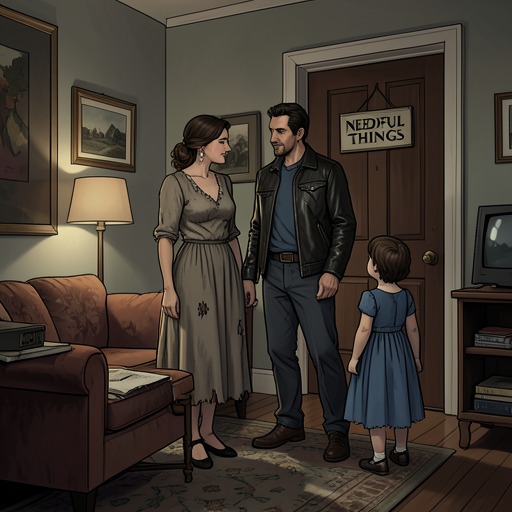
Cora first appears as a domestic presence organized around television, food, and telephone conversations. Reclining on the sofa with chocolate-covered cherries while watching Santa Barbara, she dismisses Needful Things as an ordinary antique shop before it has even opened. The store’s cryptic advertising and new green awning instead provoke her curiosity and irritation: she suspects its proprietor is being deliberately secretive and complains to Myra that Castle Rock already has too many shops selling junk. Her certainty that the subject should be closed contrasts with Brian’s attentive curiosity; he listens while doing his homework and recognizes that her annoyance is partly a desire to know what the new shop contains.
Her sharpness at home has consequences for how Brian approaches her. When he asks what the name Needful Things means, she cuts him off because she is busy telephoning Myra, and offers him a Devil Dog from the breadbox instead. Brian loves his mother but sometimes loses his appetite watching her eat, and he knows that her shouting makes it prudent to seek shelter. These observations establish both his affection and the apprehension shaping their household: Cora is not simply a comic observer of the town’s new business, but a forceful presence whose moods her son carefully monitors.
The Elvis Portrait and Gaunt’s Manipulation
Cora’s enthusiasm becomes concrete when she and Myra enter Needful Things and go straight to the glass case holding an Elvis picture. Their shared avidity conceals a rivalry that Gaunt can exploit. Myra later returns to the store secretly, knowing Cora wants the picture too and fearing that her friend would never speak to her again if she knew why Myra had come. Myra justifies her visit to herself with the logic of getting there first and keeping the truth from Cora. The friendship thus supplies Gaunt with a ready-made fault line: both women want the same object, and each acts without the other’s knowledge.
When Cora comes in determined to buy the picture, Gaunt tells her it has already been sold, ostensibly to a woman from out of state whose car had Oklahoma plates. Cora is genuinely distressed; she had not understood how badly she wanted the image until she learned it was gone, and she hates the supposed buyer. Gaunt then produces a small lizard-skin spectacles case. Inside are smoky-gray aviator glasses he presents as Elvis’s sunglasses, one of sixty pairs and, he claims, among the King’s favorites. Cora’s breath catches and her hand rises to her throat. The quick substitution turns the loss of a collectible into a more intimate promise: rather than simply owning another image of Elvis, she is offered a means of entering an imagined world centered on him.
Gaunt also makes Cora useful against Alan Pangborn. While she stands holding the sunglasses case, he asks whom he could use to keep an eye on the sheriff. Cora names Polly Chalmers, correctly observing that Polly is deeply attached to Alan, but Gaunt rejects the suggestion as an obvious choice. Cora then proposes Eddie Warburton, the head custodian at the Municipal Building. Gaunt accepts enthusiastically, calls him “The janitor!” and praises the choice as “Fifth Business!” Her suggestion shows how Gaunt draws a practical act of observation out of a customer whose attention is already clouded by the bargain.
Graceland as Refuge
The sunglasses give Cora access to an elaborate Elvis fantasy. While Brian is thinking about suicide and whispering desperately with Gaunt over his own bargain, Cora dances around her bedroom in her housecoat, experiencing the room as Graceland. She dances to Elvis records, including “Blue Hawaii,” amid its jungle-room décor and theatrical furnishings. The contrast is severe: her son is upstairs, isolated with thoughts of a shotgun and an alibi, while she dances below in a private scene that excludes his suffering. The glasses do not merely decorate her Elvis collection; they suspend her attention in a gratifying alternate reality at the moment her household is approaching disaster.
The division between mother and son becomes even more pronounced as Brian deteriorates. His father, seated behind a newspaper at breakfast, complains about the Patriots; Cora tells him not to swear in front of the boys, but without her usual force. She seems distant and preoccupied. Later, after Brian has heard of the two women murdered in a murderous dispute and keeps circling thoughts of Gaunt, his baseball card, and possible violence, Cora again plays her scratchy Elvis records. She dances in the imagined Graceland with the sunglasses masking her eyes while Brian lies on his bed thinking about Sandy Koufax and shotguns. The repeated juxtaposition makes the fantasy a form of isolation: Cora is physically in the same home as her son but absorbed in an experience that screens his crisis from her.
Loss, Grief, and the Broken Glasses
After Brian’s death, Cora is questioned at the Rusk home by detectives from the Criminal Investigation Department. Alan Pangborn finds her responses slow and unfocused; she is not quite weeping and cannot concentrate well enough to provide useful answers. Whether shock or medication accounts for her state, she keeps saying that she knows nothing and that Brian is poor Brian. The detectives have taken over the investigation, and Alan understands that he has been pushed out of the immediate work. In this first aftermath, Cora’s grief is visible but difficult to reach through her stunned, distracted answers.
Her next appearance makes clear how completely Gaunt’s influence has redirected her attention. Cora walks slowly down Main Street toward Needful Things, carrying broken sunglasses. She is angry at the police for asking questions about Brian and follows the counsel Gaunt supplies in her mind: she tells them she wants to go to the hospital to see her surviving son, which gets them to leave her alone. She even produces tears, but the thought behind them is that Elvis must be lonely without her. The scene does not erase her loss; it shows how thoroughly the fantasy has displaced her capacity to face it. The broken glasses are both the material remnant of the illusion and an object she cannot bring herself to discard.
Alone in her room, Cora puts the glasses back on and returns to Graceland. She crosses the imagined mansion to the King’s black-and-white bedroom, with its white rug, dark furnishings, and midnight-blue ceiling dotted with electric stars. There, the scene that had promised private access to Elvis turns against her: he is in bed with Myra. Cora rushes at her supposed friend, intent on tearing out her eyes, but Myra tears the sunglasses from Cora’s face. Cora opens her eyes in her own bed, and the glasses lie on the floor with both lenses shattered. The fantasy’s collapse is made physical and irreversible; the treasured object that carried her into Graceland can no longer do so.
Violence and Narrative Significance
The broken illusion does not lead Cora back toward her family or into reconciliation with Myra. Instead, anger takes the place of the fantasy. Armed and in the rain, she goes to Myra’s house, smashes a kitchen-door window with a painted rock, clears the broken glass with her pistol, and enters. When Garfield the cat runs toward her, she shoots him. She then heads upstairs, certain that Myra will be in bed. The progression from jealous vision to real intrusion turns the rivalry that began around an Elvis picture into a direct assault on her friend.
Myra is waiting with a pistol of her own. She tells Cora that Gaunt predicted she would come, then fires; the bullet passes Cora’s cheek and hits the plaster. Cora returns fire, striking the picture between Myra’s legs and wounding her in the upper thigh. The exchange exposes how completely Gaunt has converted the women’s friendship and shared desire into mutual suspicion: even at the point of violence, his foreknowledge is part of the confrontation. Cora’s arc connects the shop’s seductive promise of possession to its human cost. The sunglasses offer an imagined intimacy with Elvis, but the desire to possess that vision intensifies her estrangement from Brian’s suffering, distorts her bond with Myra, and ends in shattered glass and gunfire.